Welcome STARK TOUCH DEVICE!


Solutions
Serial port data transparent transmission of industrial control computers
Serial Data Transparent Transmission in Industrial Control Computers
Core Principles of Transparent Transmission
Transparent transmission in industrial control computers refers to the process where serial data is transferred between devices without any modification to its original format, content, or sequence. This technology ensures that the receiving end obtains the exact same data as sent from the transmitting end, maintaining data integrity throughout the communication chain.
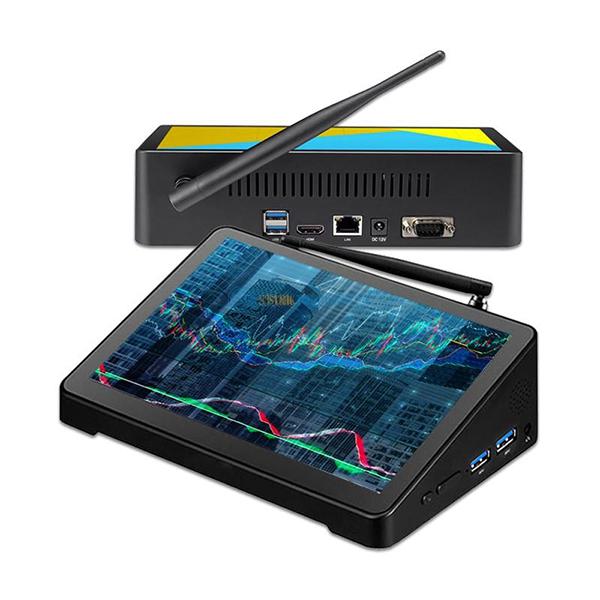
The foundation of transparent transmission lies in the seamless conversion between serial communication protocols and network protocols. For instance, when connecting a Remote Terminal Unit (RTU) that only supports serial communication to a server requiring IP-based communication, a transparent transmission module acts as an intermediary. It packages serial data received from the RTU into IP packets and transmits them over the network to the server. Conversely, it unpacks IP packets received from the server and converts them back into serial data for the RTU. This bidirectional conversion enables real-time monitoring and control of field devices from remote locations.
Key Factors Influencing Stability
Hardware Reliability
The stability of serial data transparent transmission heavily depends on the reliability of the hardware components involved. Industrial-grade processors designed to withstand extreme temperatures, voltage fluctuations, and mechanical vibrations are essential. These processors ensure consistent performance even in harsh industrial environments, where temperatures can range from sub-zero to high levels, and voltage spikes are common.
In addition to processors, the choice of serial communication modules and power supply units also plays a crucial role. High-quality serial modules with robust electrical characteristics can minimize data transmission errors caused by electromagnetic interference (EMI). Similarly, power supply units with wide input voltage ranges and built-in EMI filtering can shield the system from power-related disturbances, ensuring stable operation.
Software Optimization
Software optimization is equally important for achieving stable transparent transmission. Real-time operating systems (RTOSes) are often preferred over general-purpose operating systems for industrial control applications due to their deterministic performance. RTOSes guarantee task execution within strict time constraints, ensuring that serial data is generated and transmitted with precise timing. This is critical in applications like motion control, where even minor delays can lead to system instability or equipment damage.
Fault-tolerant software designs further enhance stability by enabling the system to detect and recover from hardware or software failures. For example, redundant control algorithms can be implemented to ensure continuous operation even if one component fails. Additionally, watchdog timers can be used to monitor the health of software processes and reset frozen or malfunctioning tasks, preventing system crashes.
Implementation Strategies
Serial-to-Network Transparent Transmission
One of the most common implementation strategies is serial-to-network transparent transmission. This involves using Data Transmission Units (DTUs) or intelligent gateways with transparent transmission capabilities to connect serial devices to a network. The DTU packages serial data into IP packets and transmits them over Ethernet, 4G, or other network technologies to a remote monitoring platform. At the receiving end, the platform unpacks the IP packets and converts them back into serial data for processing.
This strategy is widely used in industrial automation, where PLCs and other control devices need to be remotely monitored and controlled. By enabling seamless communication between serial devices and network-based monitoring systems, it facilitates real-time data acquisition, fault diagnosis, and remote maintenance, improving overall system efficiency and reliability.
Wireless Transparent Transmission
Wireless transparent transmission is another effective strategy, particularly suitable for applications where wired connections are impractical or costly. Low-power wide-area network (LPWAN) technologies like LoRa and NB-IoT can be used to transmit serial data over long distances with minimal power consumption. These technologies are ideal for deploying sensors and actuators in remote or hard-to-reach locations, such as agricultural fields, oil pipelines, or smart cities.
Wireless transparent transmission modules typically consist of a transmitter and a receiver. The transmitter converts serial data into wireless signals and transmits them over the air, while the receiver captures these signals and converts them back into serial data. This wireless bridge enables devices to communicate without the need for physical connections, reducing installation costs and improving flexibility.
Application Scenarios
Industrial Automation
In industrial automation, serial data transparent transmission is extensively used for PLC remote monitoring and control. By connecting PLCs to remote monitoring systems via DTUs or wireless modules, operators can monitor production processes in real-time, detect faults early, and make adjustments as needed. This not only improves production efficiency but also reduces downtime and maintenance costs.
For example, in a car assembly plant, transparent transmission technology can be used to monitor the status of robotic arms and conveyor belts. By transmitting serial data from these devices to a central control room, operators can ensure that they are operating correctly and take immediate action if any issues arise. This level of real-time monitoring and control is essential for maintaining high production quality and efficiency.
Environmental Monitoring
Environmental monitoring is another area where serial data transparent transmission plays a vital role. Sensors deployed in various locations, such as air quality monitoring stations, water treatment plants, or weather stations, generate large amounts of data that need to be transmitted to a central monitoring center for analysis. Transparent transmission technology enables these sensors to communicate with the monitoring center seamlessly, regardless of their physical location.
For instance, in a smart agriculture application, soil moisture sensors can be connected to a wireless transparent transmission module. The module transmits serial data from the sensors to a cloud-based monitoring platform, where farmers can access real-time information about soil conditions. Based on this data, they can make informed decisions about irrigation and fertilization, optimizing crop growth and reducing water waste.