Welcome STARK TOUCH DEVICE!


Solutions
Selection of integration degree for industrial control computers in embedded scenarios
Selecting Integrated Industrial Control Computers for Embedded Scenarios
In the era of Industry 4.0, embedded industrial control computers have become the cornerstone of smart manufacturing, enabling seamless integration of automation, data processing, and edge computing. When selecting these devices for embedded applications, integration level is a critical factor that directly impacts system reliability, cost-efficiency, and scalability. This guide explores key considerations for choosing integrated industrial control computers tailored to embedded environments.
Core Integration Requirements for Embedded Systems
All-in-One Design vs. Modular Architecture
Embedded systems often operate in space-constrained environments, such as robotic arms, medical devices, or AGVs. Here, the choice between all-in-one and modular designs is pivotal:
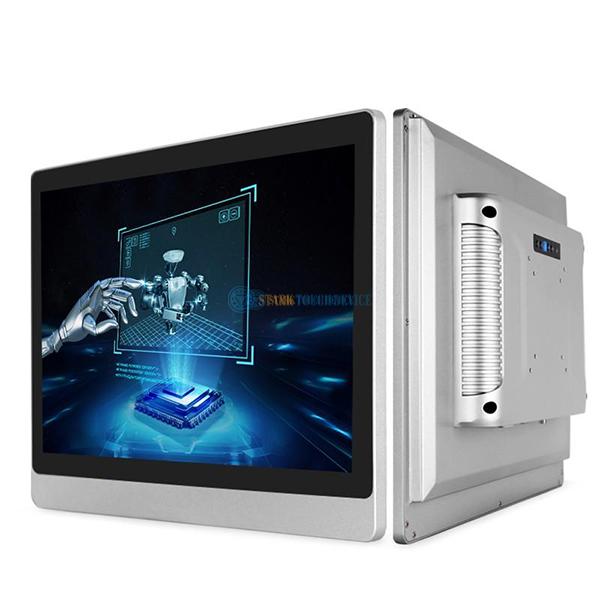
All-in-One Integration: Devices with integrated displays, touch panels, and I/O interfaces reduce wiring complexity and physical footprint. For example, a 10.1-inch capacitive touchscreen embedded in a CNC machine controller enables operators to adjust parameters directly on the machine, eliminating the need for external monitors. This design is ideal for human-machine interaction (HMI) in compact spaces.
Modular Architecture: For applications requiring flexibility, such as multi-sensor data acquisition or protocol conversion, modular designs with PCIe slots or Mini-PCIe expansion allow customization. A device with 4x RS-485 ports and 2x Gigabit Ethernet can be upgraded with a CAN bus module for automotive testing rigs, ensuring adaptability to evolving requirements.
Performance vs. Power Efficiency
Embedded systems must balance computational power with energy consumption, especially in battery-powered or solar-driven applications:
High-Performance Demands: Machine vision inspection systems require multi-core processors (e.g., ARM Cortex-A72 or x86-based) to process high-resolution images in real time. A device with an NVIDIA Jetson AGX Xavier module can handle 32-channel video analytics for quality control in semiconductor manufacturing.
Low-Power Optimization: For IoT gateways in agricultural fields, ARM Cortex-M7-based controllers with sub-5W power draw are sufficient. These devices collect soil moisture data from 100+ sensors while operating on solar panels for 5+ years without maintenance.
Environmental Adaptability in Embedded Deployments
Ruggedness for Harsh Conditions
Embedded industrial control computers must withstand extreme temperatures, vibrations, and contaminants:
Thermal Resilience: Devices with fanless designs and wide-temperature ranges (-40°C to 85°C) are essential for oil pipeline monitoring in deserts or Arctic research stations. A compact unit embedded in a pipeline valve can tolerate 140°C steam while transmitting pressure data via LoRaWAN.
Vibration & Shock Proofing: For AGVs in logistics warehouses, MIL-STD-810G-certified devices with anti-vibration mounts ensure stable operation during rapid acceleration/deceleration. A 15cm×10cm unit with M12 connectors can process lidar data while enduring 5G vibrations.
Dust & Water Ingress Protection
In food processing or mining, IP67-rated devices prevent failures caused by particulates or moisture:
Sealed Enclosures: A stainless-steel embedded computer with IP67 rating can be hosed down daily in meat processing plants without compromising functionality. Its M12 connectors resist corrosion from saline environments in coastal facilities.
Chemical Resistance: For pharmaceutical manufacturing, devices with anti-corrosive coatings and hermetic seals withstand frequent alcohol disinfection cycles, ensuring compliance with hygiene standards.
Connectivity & Expansion for Embedded Ecosystems
Wired & Wireless Protocol Support
Embedded systems often act as edge nodes, requiring diverse communication interfaces:
Industrial Fieldbuses: Devices with native support for PROFINET, EtherCAT, or Modbus TCP enable seamless integration with existing PLC networks. A unit with 4x PROFINET ports can synchronize 100+ motor drives in automotive assembly lines with sub-millisecond latency.
Wireless Technologies: For mobile applications like drone swarms, 5G/Wi-Fi 6 dual-mode modules ensure low-latency telemetry. A device with Bluetooth 5.3 can connect to 200+ BLE sensors in smart factories for real-time equipment health monitoring.
PREVIOUS:Anti-interference requirements for industrial control computer protection configuration
NEXT:Computing power matching for industrial control computers in large factories